
Arctic Route Militarization & Polar Resource Competition — The Emerging Northern Frontier
Vyadh Intelligence Brief — Issue 16
Vyadh Colloids
3/5/20261 min read
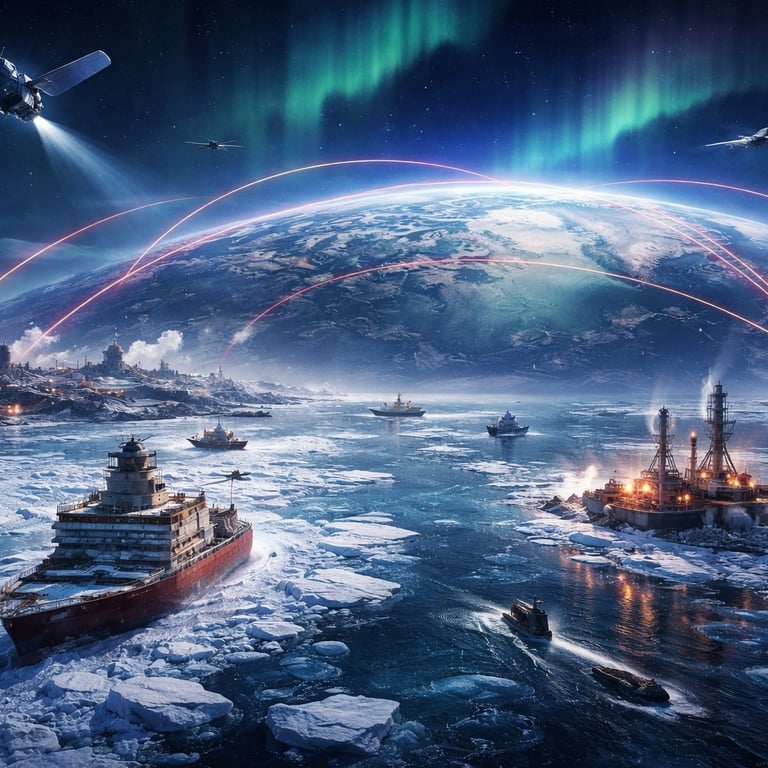
Strategic Premise
The Arctic was historically inaccessible.
Climate change is transforming it into a strategic corridor.
Melting ice is unlocking:
New maritime trade routes
Untapped hydrocarbon reserves
Rare earth mineral access
Strategic military positioning
The Arctic is evolving from environmental frontier → geopolitical competition zone.
1. Arctic Strategic Geography
Key Strategic Routes:
Northern Sea Route
Northwest Passage
Arctic Ocean
Primary Arctic States:
Russia
United States
Canada
Norway
Denmark
2. Structural Drift Indicators
Low-Visibility Signals:
Arctic military base modernization
Icebreaker fleet expansion
Satellite surveillance coverage increase
Resource exploration licensing in polar waters
Shipping trials along Northern Sea Route
Entropy Score: Emerging Strategic Activation
The Arctic is transitioning from scientific cooperation → strategic competition.
3. Compression Points
A. Maritime Route Advantage
Arctic routes shorten Asia–Europe shipping distances by ~30–40%.
B. Resource Access
Estimates suggest the Arctic holds large shares of undiscovered oil and natural gas.
C. Military Early Warning Systems
Polar geography is critical for missile detection and surveillance.
D. Environmental Governance Conflict
Competing legal interpretations of maritime rights.
4. Strategic Compression Output (SCO)
Within the next decade, Arctic maritime routes will shift from seasonal experimental corridors to strategically monitored trade lanes, increasing military presence and geopolitical tension in the polar region.
Impact Cascade:
Shipping route diversification
Energy exploration acceleration
Naval patrol expansion
Environmental governance disputes
New geopolitical alliances in polar regions
5. Escalation Triggers
Activate Monitoring Protocol if:
Permanent naval deployments along Arctic routes
Territorial claim disputes intensify
Major commercial shipping line commits to regular Arctic transit
Arctic resource discovery with large-scale extraction plans
Strategic Assessment
The Arctic represents the next geopolitical frontier.
Unlike traditional conflict zones, its transformation is driven by climate dynamics combined with strategic opportunity.
Competition here will be slow, infrastructure-driven, and long-term —
but once established, the new northern corridors could reshape global trade flows.
Vyadh Colloids
© 2026. All rights reserved Vyadh Colloids Pvt. Ltd.
Quantum ID: V0Y9A8D5H3C7O3L8L9O4I6D2S1V2C7DP
Engineering Strategic Intelligence for a Complex World.