
Critical Minerals & Resource Control — The New Geopolitical Substrate
Vyadh Intelligence Brief – Issue 20
Vyadh Colloids
3/10/20261 min read
Strategic Premise
Industrial revolutions have always been anchored in resource control.
Coal powered the 19th century
Oil defined the 20th century
Critical minerals will shape the 21st century
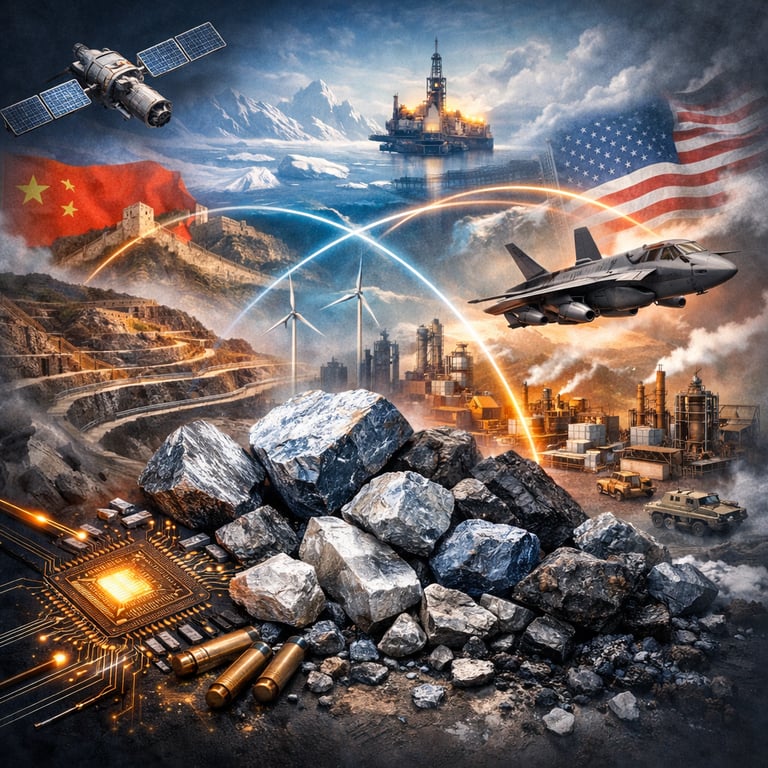
Modern technologies — from AI infrastructure to renewable energy — depend on a small set of geographically concentrated minerals.
Control over these resources increasingly determines technological sovereignty and industrial power.
1. Global Critical Mineral Distribution
Key Minerals Driving Strategic Competition:
Lithium
Cobalt
Nickel
Rare earth elements
Graphite
Primary production regions include:
China
Democratic Republic of the Congo
Australia
Chile
These minerals underpin:
Electric vehicle batteries
Renewable energy systems
Semiconductors
Military electronics
2. Structural Drift Indicators
Low-Visibility Signals:
Export controls on rare earth processing
Strategic mineral stockpiling programs
Government subsidies for domestic mining
Vertical integration of battery supply chains
Exploration expansion in new regions
Entropy Score: High Strategic Competition
Critical mineral supply chains are becoming national security priorities.
3. Compression Points
A. Geographic Concentration
Certain minerals are heavily concentrated in a few countries, creating potential supply chokepoints.
B. Processing Dominance
Mining alone is not decisive.
Refining and processing capacity determine real control over supply chains.
C. Energy Transition Demand
Electric vehicles, energy storage, and renewable infrastructure dramatically increase mineral demand.
D. Environmental and Political Constraints
Mining projects often face regulatory, environmental, and social challenges that slow expansion.
4. Strategic Compression Output (SCO)
Within the next two decades, critical minerals will become central to geopolitical competition, with states seeking supply diversification, domestic processing capabilities, and strategic alliances to secure access.
Impact Cascade:
Industrial policy expansion
Strategic mineral alliances
Export control regimes
Resource nationalism
Technology supply chain realignment
5. Escalation Triggers
Activate Monitoring Protocol if:
Major mineral export restrictions imposed
Supply chain disruptions affecting technology production
Discovery of large new deposits in geopolitically sensitive regions
Strategic alliances formed specifically around mineral access
Strategic Assessment
Critical minerals represent the material backbone of the technological age.
Control of these resources will influence:
Energy transition
Military capability
Semiconductor manufacturing
AI infrastructure development
In the 21st century, geopolitical competition will increasingly occur not only over territory but over subsurface resources that enable advanced technology.
Vyadh Colloids
© 2026. All rights reserved Vyadh Colloids Pvt. Ltd.
Quantum ID: V0Y9A8D5H3C7O3L8L9O4I6D2S1V2C7DP
Engineering Strategic Intelligence for a Complex World.