
Decision Context Window: The Hidden Constraint on Institutional Action
Vyadh Intelligence Brief — Issue 03
Vyadh Colloids
2/19/20262 min read
Executive Summary
Modern institutions are not constrained by lack of information.
They are constrained by context overload at the moment of decision.
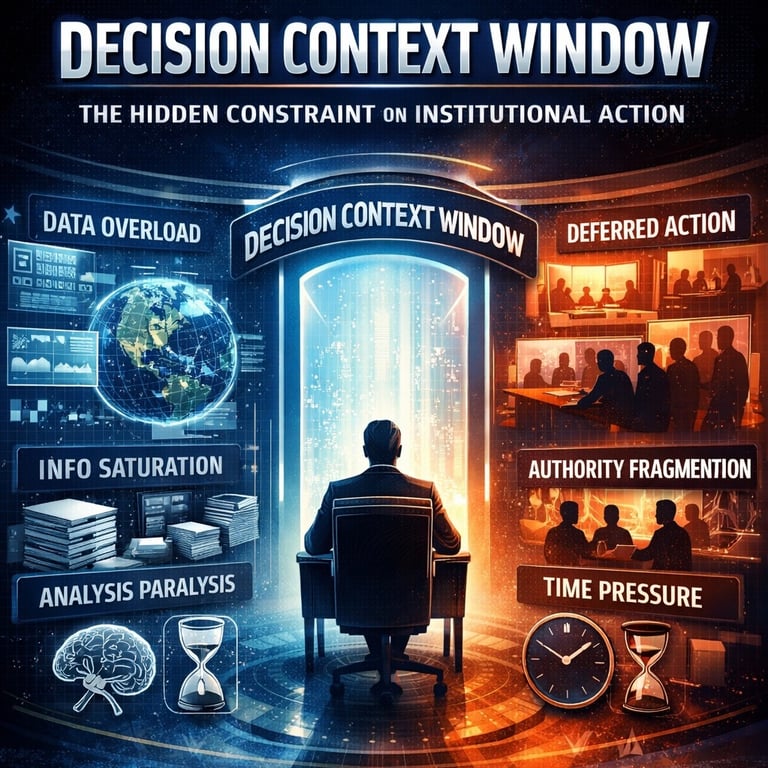
Vyadh’s Advanced Intelligence Modelling identifies a structural failure pattern we define as the Decision Context Window (DCW):
The finite cognitive, institutional, and temporal bandwidth within which intelligence can be converted into decisive action.
When intelligence inflow exceeds this window, decision velocity declines — even as analytical output increases.
This brief outlines the DCW model, structural failure modes, and operational corrections for high-complexity systems.
I. Strategic Context
Across governments, financial systems, defense architectures, and corporate environments:
Data production is exponential
Analytical capability is expanding
Real-time dashboards are ubiquitous
AI summarization tools are proliferating
Yet:
Decisions slow
Risk tolerance declines
Committees expand
Action shifts toward symbolic signaling
This is not incompetence.
It is context saturation.
II. The Decision Context Window (DCW) Model
The DCW model operates across three structural layers:
1. Cognitive Layer
Human decision-makers operate under:
Finite working memory
Selective attention constraints
Escalating risk sensitivity under ambiguity
Excessive variables trigger defensive cognition:
Preference for reversible decisions
Deferment disguised as “further review”
Consensus dependency
Decision energy collapses before commitment.
2. Institutional Layer
Organizational dynamics amplify context overload:
Report production exceeds absorption capacity
Advisory nodes multiply
Cross-functional inputs create friction
Accountability disperses
The system appears informed.
But no single actor feels context-complete enough to act.
3. Temporal Layer
Time interacts nonlinearly with context density.
Three failure modes emerge:
Overextension Mode – Too much context, too little time → rushed symbolic action
Compression Mode – Artificial narrowing of context → blind spots
Suspension Mode – Decision deferred → environment advances
In volatile threat environments, suspension mode is the most destabilizing.
III. Comparative Structural Patterns
Strategic Multilateral Environments
United Nations Security Council
High actor diversity, legal constraints, and geopolitical signaling generate extreme context density.
Action frequency declines despite high intelligence input.
Financial Shock Environments
Lehaman Brothers
Complex exposure models and conflicting internal risk assessments saturated executive context windows.
Consensus formed only after systemic collapse became irreversible.
National Security Decision Nodes
National Security Council
Real-time intelligence inflow, political consequence modelling, and international implications create oscillation between over-contextualization and emergency narrowing.
The instability is structural, not personal.
IV. The Inversion Threshold
The DCW model identifies an inversion point:
Beyond a certain threshold, additional intelligence reduces decisiveness rather than improving it.
Indicators of inversion:
Increased briefing length, decreased action
Expansion of dashboards without clarity gain
Rising “monitoring posture” without commitment
Repeated scenario modelling without execution
Modern institutions rarely detect this inversion in real time.
V. Operational Implications
Expanding analytical capacity does not expand decision capacity.
DCW optimization requires:
1. Pre-Structured Decision Frameworks
Defined variables before crisis onset.
2. Authority Clarity
Single accountable decision nodes at threshold moments.
3. Trigger-Based Pathways
Pre-authorized actions when measurable thresholds are crossed.
4. Context Cut-Off Protocols
Freeze synthesis after defined input volume; defer late inputs to next cycle.
5. Context Saturation Audits
Measure:
Report volume vs decision rate
Meeting hours vs execution outputs
Intelligence flow vs action latency
VI. Strategic Advantage
The competitive edge in modern intelligence environments will not belong to those with:
The most data
The most dashboards
The most analysts
It will belong to those who:
Architect context deliberately
Detect inversion thresholds early
Convert bounded intelligence into decisive action
VII. Vyadh Positioning
The Decision Context Window framework extends Vyadh’s foundational thesis of the Analysis Surplus Economy.
If analysis surplus explains why information exceeds action capacity,
DCW explains where and how the collapse occurs.
Within Vyadh’s Quantum Decision Intelligence Architecture, the objective is not:
To increase intelligence.
But to engineer context precision.
Closing Assessment
Institutions fail less often from ignorance than from context saturation.
The next evolution of intelligence systems must shift from:
Data expansion → Context design
Analysis accumulation → Action architecture
Information abundance → Decision velocity
Decision superiority will be achieved not by knowing more — but by knowing enough within the window that matters.
Vyadh Colloids
© 2026. All rights reserved Vyadh Colloids Pvt. Ltd.
Quantum ID: V0Y9A8D5H3C7O3L8L9O4I6D2S1V2C7DP
Engineering Strategic Intelligence for a Complex World.