
The Analysis Surplus Economy: Why Modern Systems Fail to Convert Information into Action
Vyadh Intelligence Brief — Issue 02
Vyadh Colloids
2/18/20263 min read

I. Protocol Context
Modern institutions operate within an environment defined not by information scarcity, but by analysis saturation. Across governments, corporations, financial systems, and security environments, the volume of analytical output has increased exponentially. Yet observable decision quality and decision velocity have not increased proportionally.
This divergence represents a structural failure rather than a temporary inefficiency.
The core problem is not insufficient intelligence.
The problem is the absence of intelligence synthesis as an operational function.
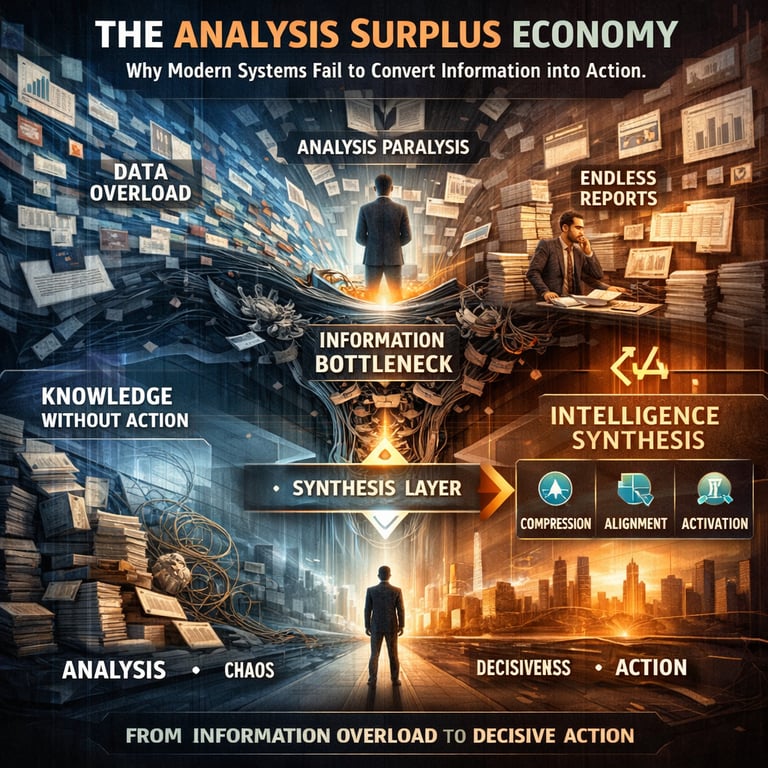
This synthesis examines the emergence of what can be termed the Analysis Surplus Economy — a condition where information production exceeds institutional capacity to convert understanding into action.
II. The Expansion of Analytical Output
Over the last two decades, three reinforcing dynamics have reshaped institutional cognition:
Data Abundance
Sensor networks, digital exhaust, open-source intelligence, and automated reporting produce continuous informational inflow.
Information accumulation is now structurally cheaper than decision-making.
Analytical Specialization
Institutions fragment analysis into domain silos.
Outputs become locally optimized but globally incoherent.
Technological Amplification
Analytical tools increase the rate of interpretation without increasing responsibility for decision outcomes.
The result is a system optimized for producing explanations, not for enabling decisions.
Analysis becomes an end-state rather than an input to action.
III. The Decision Velocity Paradox
Contrary to expectation, increased intelligence input has correlated with slower decision cycles.
This occurs because:
Additional information expands perceived uncertainty.
Every new analytical layer introduces alternative interpretations.
Decision-makers face expanding justification requirements.
As informational volume increases, organizations shift from asking:
“What should we do?”
to:
“What have we not yet considered?”
Decision processes become recursive. Analysis generates more analysis.
Velocity declines not due to incompetence, but due to risk amplification through information density.
IV. Risk Avoidance as an Emergent Property
In analysis-surplus environments, risk avoidance emerges organically.
Key mechanisms:
Diffusion of accountability: More analysis distributes responsibility.
Defensive analysis production: Teams produce intelligence to avoid blame rather than enable action.
Reversibility preference: Organizations prefer options that delay commitment.
The system unconsciously optimizes for error avoidance, not outcome achievement.
This produces the illusion of rationality while reducing adaptability.
The organization appears informed but behaves cautiously to the point of strategic paralysis.
V. Decision Bandwidth as the Limiting Resource
The fundamental constraint is not data processing capacity but decision bandwidth.
Decision bandwidth consists of:
Cognitive capacity of decision-makers
Organizational tolerance for uncertainty
Alignment between analysis and authority
Temporal constraints on action
While analytical capacity scales technologically, decision bandwidth scales slowly because it is human and structural.
When analytical output exceeds decision bandwidth:
Signal-to-noise ratios collapse.
Priority clarity declines.
Action thresholds continuously move forward.
The system accumulates intelligence it cannot metabolize.
VI. Intelligence Synthesis as the Missing Layer
Modern institutions possess:
Collection
Analysis
Reporting
What is missing is synthesis — the operational translation layer between understanding and action.
Intelligence synthesis performs three functions:
Compression
Reduces analytical complexity into decision-relevant structure.
Alignment
Connects information to organizational objectives and constraints.
Activation
Converts insight into executable decision pathways.
Synthesis does not add more analysis.
It reduces analytical entropy.
Where analysis expands possibility space, synthesis collapses it into actionable reality.
VII. Structural Implication
The Analysis Surplus Economy represents a systemic transition:
Previous Era - Current Era
Intelligence scarcity - Intelligence abundance
Analysis as advantage - Decision clarity as advantage
Information access - Action coherence
Faster analysis - Better synthesis
Competitive advantage shifts from knowing more to deciding coherently under informational excess.
Organizations that fail to introduce synthesis layers will continue accumulating intelligence without increasing effectiveness.
VIII. Vyadh Positioning
Within this environment, Vyadh’s role is not analytical production.
Vyadh operates at the synthesis layer.
The function is to:
Identify decision-relevant signals within analytical surplus
Model consequences across informational domains
Restore decision velocity without increasing risk exposure
Convert intelligence into structured action environments
The value proposition is therefore systemic.
Vyadh addresses a structural failure of modern intelligence systems — the inability to translate understanding into movement.
IX. Outcome
The Analysis Surplus Economy reframes intelligence itself.
The limiting factor of modern systems is no longer knowledge.
It is the ability to conclude.
Intelligence synthesis becomes the mechanism through which organizations regain agency in environments saturated with analysis.
And in such environments, the highest intelligence is not the capacity to analyze more — but the capacity to decide at the right moment.
Vyadh Colloids
© 2026. All rights reserved Vyadh Colloids Pvt. Ltd.
Quantum ID: V0Y9A8D5H3C7O3L8L9O4I6D2S1V2C7DP
Engineering Strategic Intelligence for a Complex World.